

How Does a Front Load Automatic Washing Machine Work?
Your Front Load Washing Machine time starts. The drum turns. Water fills up. Some time later, your clothes are clean. But what actually happens in between?
A front loading washing machine operates by rotating the clothes inside the machine with the help of water and soap. The machine undergoes a cycle of filling, washing, draining, rinsing, and spinning. GeneralTec sells these machines, and people ask us how they work all the time. So here’s a plain guide to the steps and the parts.
1. What is a front load automatic washing machine?
It’s a washing machine with a front-loading door. You load clothes through it.
Inside, the drum sits on its side. It turns during the wash. Around it is an outer tub, which holds the water. A few paddles on the drum wall lift the clothes and drop them again as it turns.
An automatic washing machine controls water, drum movement, rinsing, and spinning on its own. You pick a program, and it does the rest.
There’s no center agitator, as you see in some top loaders. The clothes get clean from tumbling, again and again.
2. How does a front load washing machine work step by step?
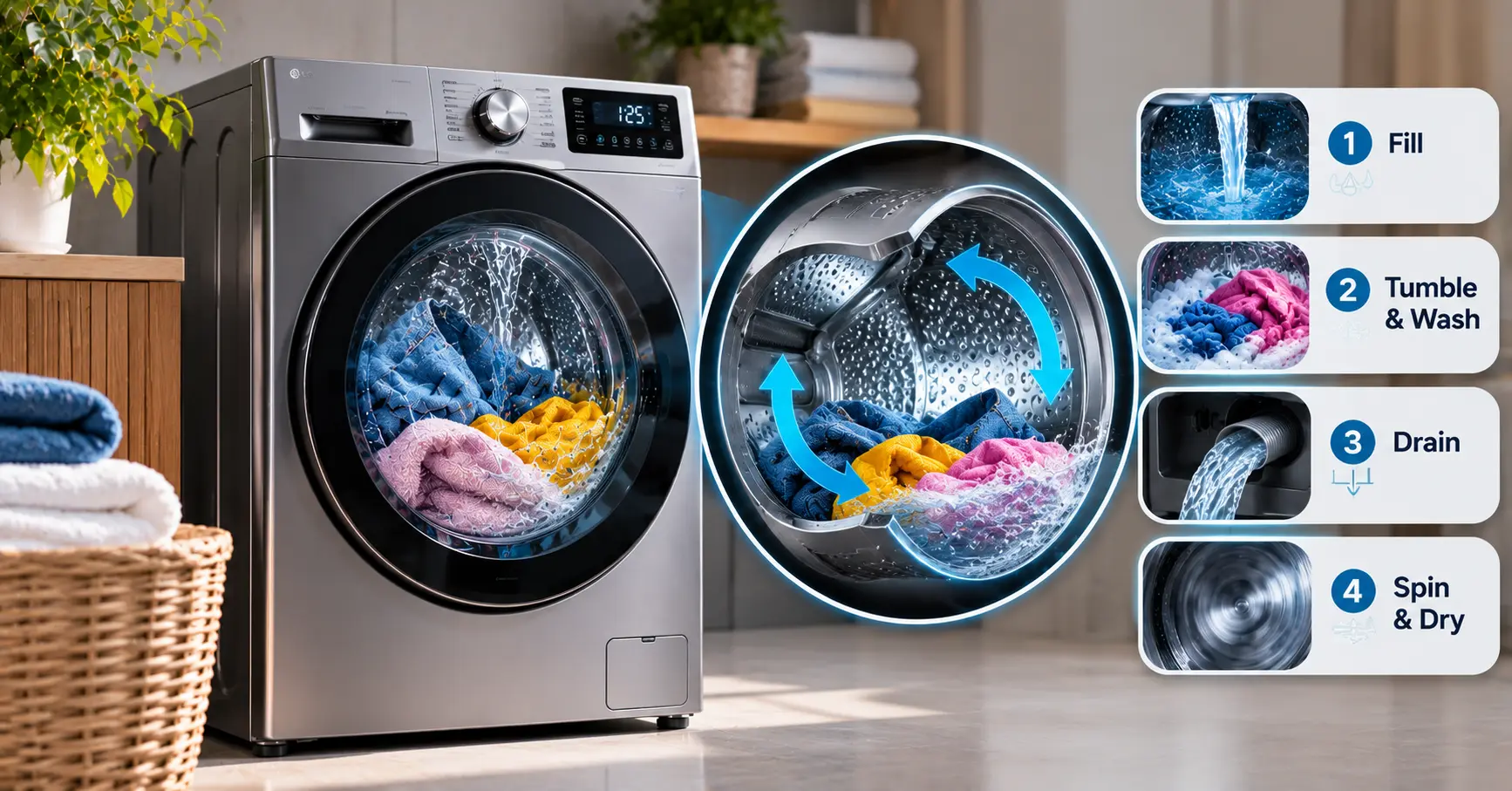
This is the front load automatic washing machine working principle, one stage at a time. It’s also what we mean by the front load washing machine washing cycle.
Step 1: Water filling and detergent dispensing
The water inlet valve opens. Water flows in. On the way, it passes through the detergent dispenser and carries the detergent into the drum.
Sensors and controls help manage the cycle. What they do depends on the program you chose and on the machine’s design.
Step 2: Washing and drum tumbling
Now the motor turns the drum. The paddles lift the clothes and drop them. Water and detergent loosen the dirt from the fabric.
Many machines change the drum’s direction now and then. That helps stop clothes from getting tangled.
That’s the basic idea behind how a washing machine cleans clothes. Water, detergent, and movement work together.
Step 3: Draining the dirty water
When the wash is done, the drain pump pushes the used water out. It goes through the drain hose and away. Then the machine gets ready to rinse.
Step 4: Rinsing with fresh water
Fresh water comes in. The clothes tumble again. This washes out leftover detergent and loose dirt. Some programs rinse more than once.
Step 5: High speed spinning
Last, the drum spins fast. Water gets thrown out through the small holes in the drum wall. The pump sends it away.
Your clothes come out damp, not dripping. That cuts down drying time. This is the washing machine spin cycle explained in simple terms.

3. What are the main parts of a front load washing machine?
Here are the front load washing machine parts and functions.
| Part | Main function |
| Inner drum | Holds clothes and rotates during washing |
| Outer tub | Contains water around the inner drum |
| Water inlet valve | Controls water entering the machine |
| Detergent dispenser | Releases detergent into the wash |
| Motor | Drives the drum’s movement |
| Drain pump | Removes used water |
| Electronic control system | Coordinates the selected wash program |
| Springs and shock absorbers | Help support the drum assembly and reduce vibration |
Load sensors are in some machines too. They help the machine read how much laundry is inside.
Want help picking a washing machine? Call GeneralTec on +971 6 881 2883 or email support@generaltec.com, and we’ll help you choose.
4. How does the washing machine motor and spin system work?
The motor turns the drum for washing and for spinning. Not every machine uses the same one, though.
- Some use a belt and pulley to drive the drum. Others use a direct drive.
- Inverter motors can change speed, depending on the machine and the cycle. Some machines use a BLDC motor.
- Springs, shock absorbers, and counterweights help control movement and shaking.
- When the drum spins fast, centrifugal force pushes the water out through the holes.
That’s why a heavy, wet load can shake a bit during the spin. The shock absorbers are there to keep that under control. A well-leveled machine helps too.
Check your model’s manual to see which motor and drive it uses.
5. Front load vs top load washing machine
Lots of people ask about front load vs top load washing machines. Here’s the difference.
| Feature | Front-load washing machine | Top-load washing machine |
| Loading method | Door at the front | Lid at the top |
| Drum position | Usually horizontal | Commonly vertical |
| Washing action | Clothes tumble and drop | Uses an agitator, impeller, or other washing action depending on the model |
| Water use | Often uses less water in comparable models | Water use varies by design and cycle |
| Adding clothes | Usually difficult once the door locks | May be possible during some cycles |
| Installation | Needs space for the front door to open | Needs clearance above the machine |
Neither one is best for everyone. It depends on your space, how you do laundry, the features you want, and your budget.
6. Why do front load washing machines use less water?
Often they do, but it isn’t a rule for every model. Here’s why.
- Clothes tumble through a fairly shallow amount of water.
- The drum’s movement spreads water and detergent around.
- Sensors and controls may change the water level to suit the load and the cycle.
How much water you use depends on the model, the load size, and the program. So don’t assume every front loader beats every top loader. Check the specs.
FAQs
How does a front load washing machine function?
The machine fills itself with water and detergent, tumbles the clothes in a horizontal drum, then drains, rinses, and spins off water. It has sensors to control all these processes.
What is the principle behind the functioning of a front load automatic washing machine?
It is designed to clean clothes by the tumbling method. The paddles make the clothes fall again and again in water and detergent.
What are the major components of a front load washer?
The inner drum, outer drum, water inlet valve, detergent dispensing mechanism, motor, drain pump, control panel, and springs with shock absorbers
How does the spin cycle work?
The drum spins fast, and centrifugal force pushes water out through the holes in the drum. A pump then removes it.
What is the function of the inverter motor?
It is capable of changing its speed according to the machine and cycle. It isn’t present in all front-loaders.
Why is my front-load washing machine shaking?
There are several possible reasons including an imbalanced load, an uneven floor, or worn shock absorbers. Make sure that your machine is balanced and that clothes are evenly distributed in it.
Are front-load washing machines using less water?
Generally yes, but again it depends on the particular model, size of the load, and the washing cycle chosen.
Is it possible to put clothes in during the cycle?
No, it usually is not, as the door becomes locked. Some front loaders allow you to put additional clothes in the first couple of minutes.
Conclusion
The front load washing machine is very simple. Water comes in, the drum turns to move the clothes, water gets removed, fresh water does the washing, and then the drum spins to remove the rest of the water from the clothes.
Once you understand how it works, it will become easy for you to choose the right program and predict problems.
Do you need help with your washing machine? Contact GeneralTec on +971 6 881 2883 or support@generaltec.com, and we’ll help you find one.










Add comment