How Does a Kitchen Hood Work? A Complete Beginner’s Guide
Ever fried pakoras with the window open and still caught the smell in your curtains two days later? A hood is meant to stop exactly that. So how is a kitchen hood used? A kitchen hood, also known as a range hood or an extractor hood, draws in smoke, grease, steam, and cooking smells from your stove using a fan, and then vents the air either to the outside of your house via ducting or cleanses it and releases it back into the room. A kitchen hood (range hood) takes out smoke, grease, steam, and cooking smells. Whether you cook in Lahore or Sharjah, a lot of frying will show the difference within a week. GeneralTec hears this question all the time, so we’ll start from the basics.
How does a kitchen hood work?
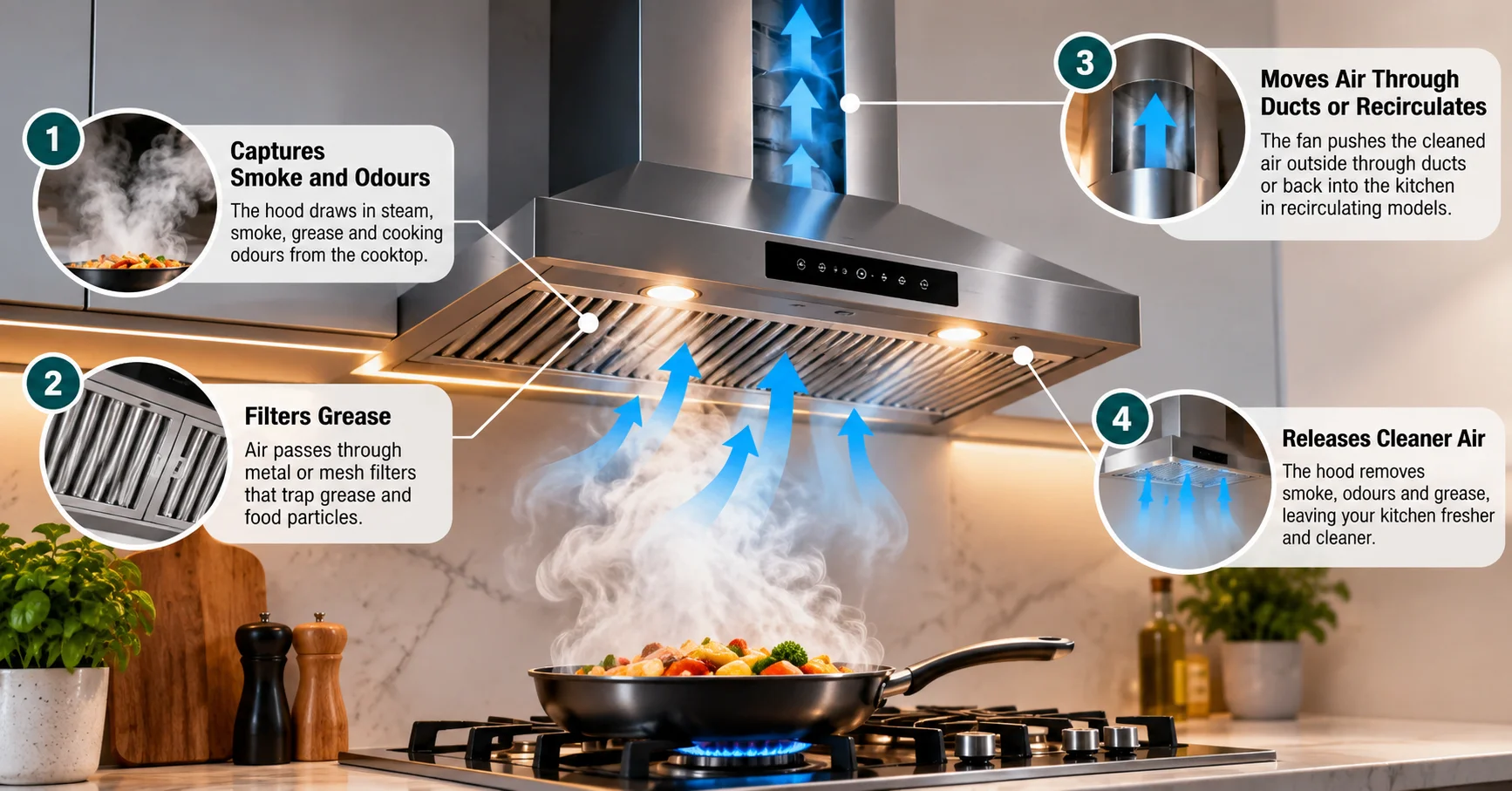
Three small jobs, one after the other.
First, it catches. The hood hangs right over your burners, and when heat, steam and smoke rise off the pan, the canopy collects that cloud before it spreads. Without it the cloud heads for your ceiling, then the walls, then the sofa.
Second, it filters. Inside there’s a fan, called the blower, and it pulls the air through metal mesh or baffle grease filters. Oil and grease droplets stick to the filters instead of coating the motor and the ductwork. A hood with clean filters simply works better.
Third, the air has to go somewhere, and there are two options.
- Ducted (vented): the air travels through a duct and gets pushed outside the house
- Ductless (recirculating): the air passes through an extra charcoal or carbon filter and comes back into the kitchen
Almost every buying decision in this guide hangs on that last choice.
Ducted vs ductless kitchen hoods
| Feature | Ducted Hood | Ductless Hood |
| Air direction | Sends air outside | Returns filtered air |
| Duct required | Yes | No |
| Smoke removal | Generally more effective | Filters air but recirculates it |
| Odor control | Removes air outside | Uses carbon filter for odors |
| Installation | More involved | More flexible |
| Filter maintenance | Grease filter | Grease and carbon filter |
A ducted hood takes the smoke out of the house, which is why it usually does the better job. A ductless one cleans the air and puts it back, and that’s perfectly fine when you can’t run a duct. We’d say a ductless hood beats having no hood at all. But if your cooktop sits near an outside wall, ducted is worth the extra installation effort.
Apartment living changes things. In many flats, in Karachi as much as in Dubai, you can’t simply drill through an outside wall, and some buildings have rules about exterior openings or shared ducts. Ask your building management before you plan a ducted install.
Your kitchen’s construction and ventilation options will decide most of this for you, so check the installation requirements before falling for a model.
Main parts of a kitchen hood
The canopy is the part you see, the body that sits above the cooking area. Behind it is the blower, a motor driven fan that creates airflow and pulls cooking air upward. In between sit the grease filters, made of metal mesh, aluminium or stainless steel, which catch grease particles on the way through.
Ductless models add charcoal or carbon filters to soak up cooking odors. Those need replacing, and the manufacturer’s instructions tell you when. Last comes the control panel, which handles fan speed and the lights.
What are the most important kitchen hood features?
Suction power
Suction power is how much air the hood can move. A stronger one helps with deep frying, grilling and other smoky cooking. Airflow is usually listed in cubic metres per hour (m³/h), and models in Pakistan right now cover a wide range, with some listing capacities up to 900 m³/h and heavy duty ones going higher.
Size
The hood should match your cooking surface or stick out a little past it. The common residential widths are around 60cm, 75cm and 90cm, and you’ll find all three across most brands.
Cleaning system
This is the feature nobody thinks about until the filter is dripping. Removable grease filters, oil collectors, auto-clean functions and parts you can reach without a ladder all make life easier. Many current models include removable filters and auto-clean technology.
Controls
Depending on the model you might get push buttons, touch controls, hand sensors or voice control. All of these are on sale in Pakistan already. Choose the one you’ll actually use, and remember that touch panels and oily fingers don’t always get along.
How big should your kitchen hood be?
A 60cm hood suits smaller cooktops and compact kitchens. A 75cm one is the middle option when you want more coverage. A 90cm hood works for larger cooktops and wider cooking areas.
The rule is simple. Choose a hood at least as wide as your cooking surface, and check the manufacturer’s installation requirements before you order. What matters is how much of the cooking area it covers, not how it looks on the wall.
How much suction power does a kitchen hood need?
Nobody can give you one number that suits every kitchen. It depends on your kitchen size, your cooktop size, how often you cook, how much you fry or grill, the length and shape of the duct, and the design of the hood itself.
If you do a lot of deep frying, grilling, high heat cooking, strong spices or steamy dishes, a stronger hood is worth it. A karahi on full flame throws up a very different cloud from a pot of daal simmering on low.
Climate plays a part too. In a Gulf summer, the windows stay shut and the AC runs all day, so smoke and steam have nowhere to go. A hood with decent suction becomes the main way your kitchen gets rid of them.
Not sure how much suction your kitchen needs? Call GeneralTec on +971 6 881 2883 or email support@generaltec.com, and we’ll help you work it out.

Kitchen hood prices and popular options in Pakistan and the UAE
Prices move with promotions and stock, so treat what follows as a snapshot and check the product page before you buy.
In Pakistan, recent listings look like this:
- NasGas: roughly the mid Rs. 20,000s up to premium models above Rs. 60,000, depending on size and features
- Dawlance: built-in hoods around Rs. 39,000 to Rs. 70,000 and above, with higher end ones past Rs. 100,000, and selected models have strong suction, touch controls, removable filters and auto-clean
- Haier and Canon: prices depend on model, size, suction and smart features, and Canon lists 60cm, 75cm and 90cm hoods with touch control, boost speed, auto-clean, hand sensors and voice control
In the UAE, prices are listed in AED and change with the retailer, hood size, suction power and features, so check the current product page instead of relying on an old figure.
How to use a kitchen hood correctly
Switch it on a minute or two before you start cooking, so the air is already moving when the oil gets hot. Most people only turn it on once the smoke appears, which is a little late.
When you finish, leave it running for another 5 to 10 minutes to clear the leftover steam and odors.
And clean the metal grease filters every month or two. Your manual has the exact schedule, and if you fry often, go sooner.
How to maintain a kitchen hood
A clogged filter chokes airflow and weakens ventilation, and that’s the main reason hoods stop working well. These habits prevent most problems:
- Clean the grease filters regularly
- Replace carbon filters when they’re due
- Wipe grease off the hood surface
- Keep the air outlet and duct clear
- Check that the blower runs properly
- Use the auto-clean function as the manufacturer describes
- Follow the installation and maintenance manual
FAQs
How does a kitchen hood work?
It captures the smoke and steam above your cooktop, catches grease in its grease filters, then either vents the air outside or recirculates it through a carbon filter.
What is the difference between a ducted and ductless kitchen hood?
A ducted hood sends air outside through a duct, while a ductless hood filters the air and returns it to the kitchen. Ducted generally clears smoke better, and ductless is easier to install.
Does a kitchen hood remove smoke and smell?
Yes, it captures cooking smoke and odors, but results depend on airflow, hood size, installation, filter condition and whether it vents outside or recirculates.
How much suction power should a kitchen hood have?
It depends on your kitchen size, cooktop, cooking style and ventilation setup. Heavy frying and grilling need stronger suction than light cooking.
How often should a kitchen hood filter be cleaned?
Check grease filters regularly and clean them every month or two, depending on how often you cook and what the manual says.
Can a kitchen hood be used without a duct?
Yes. A ductless hood cleans the air with grease and carbon filters and returns it to the kitchen.
What size kitchen hood do I need?
It should cover your cooking surface. Common sizes are 60cm, 75cm and 90cm.
Is a kitchen hood necessary for a kitchen?
In practice, yes. A hood controls smoke, grease, steam and odors, which matters most if you fry or cook on high heat often.
Final takeaway
Once you know what a hood does, buying one gets easier. It catches the plume, traps the grease and moves the air out, or cleans it and sends it back. Pick the type your kitchen can support, match the width to your cooktop, and clean the filters before they clog. Wherever you cook, if you’re unsure about anything, GeneralTec is happy to help on +971 6 881 2883 or support@generaltec.com.







Add comment