

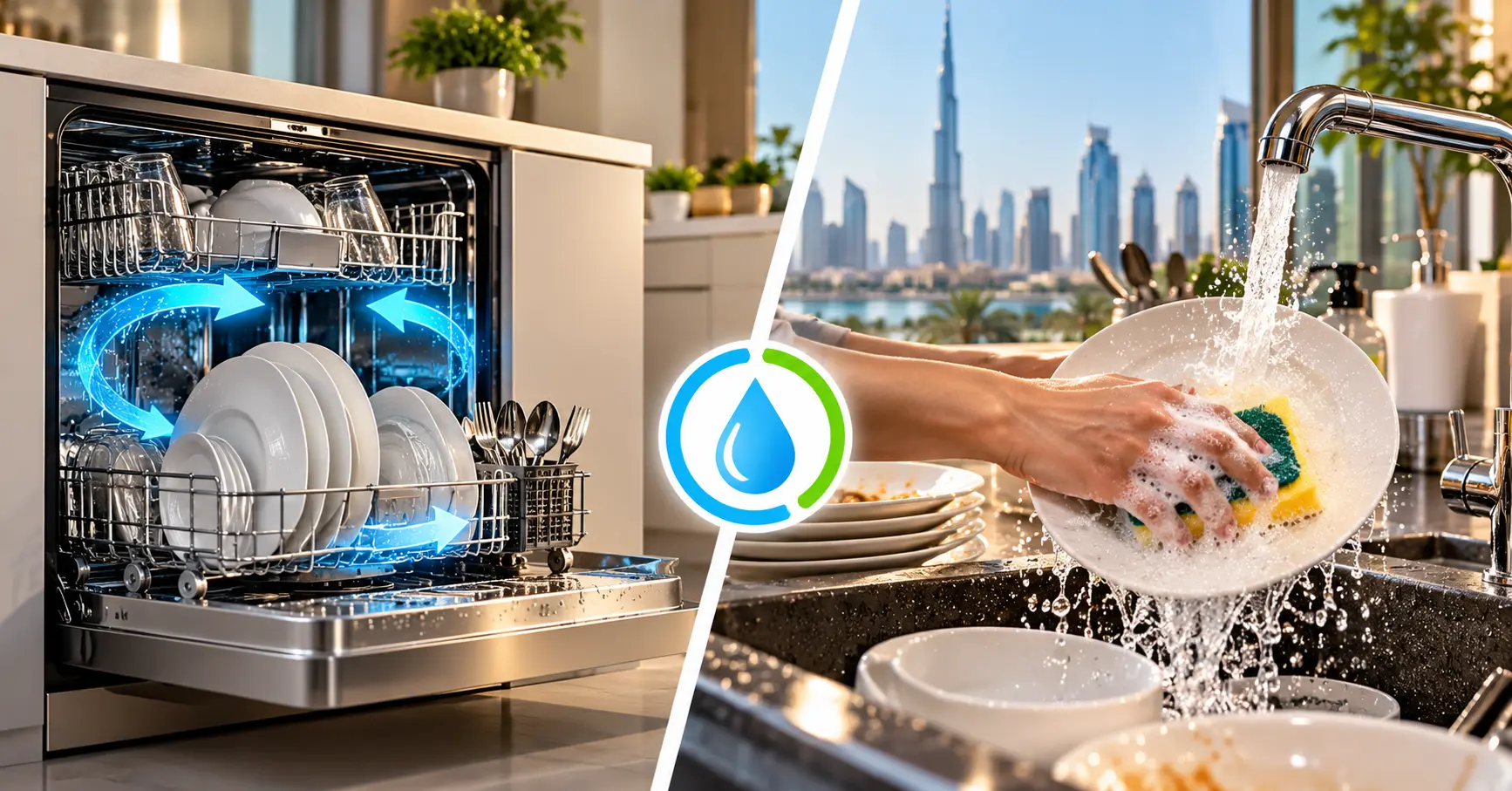
Dishwasher vs Hand Washing Which Uses Less Water in UAE Homes?
“Surely, yes. Actually, a dishwasher requires less resources for cleaning the same number of plates than hand-washing does, and the disparity between them is even more significant than most people might imagine. But it does not mean that saving water is some kind of a theoretical notion in the UAE. For after all, there is virtually no natural precipitation here, and most water should be delivered through costly desalination process.
An average dishwasher uses no more than 10 to 15 liters of water per cycle. What goes through a faucet in a dishwasher? The answer is at least 45 liters or more.” Again, this is not an advertising figure, this is a simple comparison of two processes. And we get questions like these from our clients every day at GeneralTec.
Dishwasher vs Hand WashingWhich Uses Less Water?
Here’s the comparison first, explanation after.
| Method | Approx. Water Used | How Water Is Used |
| Modern dishwasher | 10 to 15 litres per load | A small amount is filtered and recycled |
| Hand washing | 45+ litres | Running tap continuously uses fresh water |
It’s not really about the raw numbers. It’s about how the water gets used while you’re doing it. The dishwasher reuses a tiny bit throughout most of the washing cycle. The tap continues to flow, taking in new water the entire time you wash and rinse and move on to another plate.
Why Does a Dishwasher Use Less Water?
A few specific things explain most of that gap.
Water recycling. The machine filters and reuses the same water through most of a cycle instead of constantly drawing fresh, only pulling new water in at specific rinse stages.
Soil sensors. Plenty of modern machines can tell how dirty your dishes actually are and adjust water use to match. A lightly used load doesn’t get the same treatment as a pan crusted with last night’s curry.
Controlled water flow. A tap just runs until someone shuts it off. A dishwasher controls exactly how much goes in, at every stage.
No need for pre-rinsing. Scraping food off is enough. Rinsing everything under the tap before it even goes in kind of defeats the whole point.
How Much Water Can You Save in a UAE Home?
Do that comparison once, and it’s not much. Do it every day, and the difference between 10 and 15 liters versus 45+ becomes meaningful. If you do dishes every day in your house, then the disparity in the water consumed by the dishwashers is noticeable not only in specifications but in the passing days and weeks.
This is more important here than elsewhere. Quite a large portion of the UAE’s fresh water is obtained through power-intensive desalination processes rather than through precipitation – this is one of the reasons why both DEWA in Dubai and ADDC in Abu Dhabi are encouraging customers to conserve water in addition to electricity, reflected on their utility bills. It was noted by organizations such as Emirates Nature-WWF that household consumption of water is one of the key points of the sustainable development picture in the region that is relatively easy to improve, and the practice of dishwashing is included in this group.

Does a Dishwasher Also Save Energy?
Water and energy are tangled together more than people think. Heating water costs energy. Use less water, and there’s less to heat in the first place.
Today’s dishwashers operate on this principle, using the appropriate balance between water, heating, and washing cycle length, rather than working at full capacity all the time. However, the energy consumption remains dependent on the actual device used, selected cycle, and its operation mode in the household. The Abu Dhabi Department of Energy has pushed efficiency labeling on appliances for exactly this reason, since the water and energy numbers on the box only hold up if the machine gets used the way it’s rated for. Saying every dishwasher cuts your electricity bill would be a stretch. The savings are real. They’re just tied to how you actually use the thing.
Smart Dishwasher Features That Help Save Water
Shopping for a new machine? These are worth checking, not just skimming past:
- Soil sensors that adjust the cycle based on how dirty the dishes really are
- Eco cycles built for lower resource use
- Water filtration that lets water get reused mid-cycle
- Load detection that optimizes resources based on how full the machine is
- Efficient spray systems aiming water right at dishes instead of just running
Not sure which model actually delivers on this in real use, not just on paper? GeneralTec can walk you through what fits your household. Call +971 6 881 2883 or email Ac.pk@generaltec.com.
Dishwasher vs Hand Washing: Pros and Cons
| Factor | Dishwasher | Hand Washing |
| Water efficiency | Generally better with modern models | Can use much more water |
| Convenience | High | More manual work |
| Water control | Automated | Depends on user |
| Pre-rinsing | Usually unnecessary | Often done |
| Initial cost | Higher | No appliance required |
| Space | Requires installation space | Minimal space |
How to Use a Dishwasher More Efficiently in the UAE
Owning one doesn’t guarantee savings on its own. Usage does most of the work:
- Run full loads, skip the half-empty cycles
- Scrape food off instead of pre-rinsing
- Pick an eco cycle when the load allows it
- Keep filters clean, a clogged one drags performance down
- Skip long, intensive cycles for lightly soiled dishes
- Go efficient when it’s time to replace an old machine
Is a Dishwasher Better Than Hand Washing?
It all makes sense if you have a sufficient number of dishes for loading, you really worry about water consumption, you are tired of scrubbing, and there is space in your kitchen for it.
Hand washing still holds up for small households, cramped kitchens, or anyone who just doesn’t generate enough dishes to bother running a machine regularly.
For a lot of UAE households, a dishwasher genuinely wins out over hand washing under a tap. Only if it’s actually used right, though, not just sitting there half full.
Frequently Asked Questions
Do dishwashers really use less water than hand washing?
Yes. About 10 to 15 litres per cycle versus 45-plus for hand washing the same load under a running tap.
How much water does a dishwasher use per cycle?
Roughly 10 to 15 litres, though it shifts with the model, the cycle, and how full the load is.
Is hand washing dishes wasteful?
Often, yes. A continuously running tap pulls far more water than a dishwasher cycle simply because it never stops drawing fresh water.
Do dishwashers save energy as well as water?
Usually, since less water needed means less water to heat. Actual savings still depend on the appliance and cycle.
What features make a dishwasher more water efficient?
Soil sensors, eco cycles, water filtration, load detection, and precise spray systems all play into lower water use per cycle.
Is it better to pre-rinse dishes before loading a dishwasher?
Not really. Scraping’s enough. Rinsing under the tap first usually just wastes water without improving the result.
Are dishwashers worth it for small UAE households?
Not always. Very small households might do fine hand washing. Larger households running full loads see more benefit.
How can I make my dishwasher more water efficient?
Run full loads, skip pre-rinsing, use eco cycles, keep filters clean, and pick an efficient model when replacing an old one.
Conclusion
The proper use of a dishwasher makes hand washing a far worse option in terms of water usage for most UAE homes. Water recycling, soil sensors, and regulated water flow play the largest roles in this advantage, but the actual saving comes from making sure the dishwasher load is full and the cycle is correct. It should be noted that none of this implies that hand washing is a bad practice, it simply is less efficient when compared against an appliance specifically designed to regulate water flow. If water efficiency or savings matter to any degree then switching to a full load dishwasher cycle is one of the easiest things to implement.
Looking for a more water-efficient dishwasher? GeneralTec can help you find one that actually fits your household. Reach out at +971 6 881 2883 or Ac.pk@generaltec.com.











Add comment